.jpg)
The rupee on Friday touched an all-time low of 62.03 to a dollar, spooking the equities market and dragging the Sensex down to 18,621.39 in the afternoon.

Indian start-ups breathed a sigh of relief after the UK government facilitated the acquisition of the now-defunct Silicon Valley Bank's (SVB's) British arm by HSBC. In a bid to allay fears, the US Federal Deposit Insurance Corporation (FIDC) announced recently that it had transferred all deposits of start-up-focused SVB to a newly created bridge bank and all depositors would have access to their money. President Joe Biden also sought to reassure jittery depositors that they can have confidence that the US banking system is "safe".

The steep decline in commodity prices has reversed.

If the concerns over risking political capital are overcome, the long-term gains for the Indian economy will be immense, asserts A K Bhattacharya.

With the US housing and labour markets on the mend, the healing looks more durable, say RBS's Sanjay Mathur and Louis Kuijs.

Markets extended gains in afternoon trades and touched the highs of the day with buying interest seen in banking and realty shares. The Sensex was up 247 points at 17,085. Nifty is up 81 points at 5,180.
The 30-share Sensex ended 56 points lower at at 20660 levels and the 50-share Nifty scrapped 14 points at 6155 levels.

The Reserve Bank in its first mid-quarter policy review on Monday kept the key interest rates unchanged because of elevated food inflation, rupee depreciation and uncertainty over foreign fund inflows.
A potential early wind-down of the US stimulus programme and a shrink in China's factory activity pulled down markets.

The economists, polled by industry body Federation of Indian Chambers of Commerce and Industry, said the RBI may raise the cash reserve ratio, which is a portion of deposits that banks keep in cash with the central bank, by 50 basis points to 5.5 per cent, although this would have no impact on containing inflation.

Equity benchmarks mustered gains for the first time this week on Thursday as investors piled into the recently-battered metal, bank and IT stocks amid expiry of monthly derivative contracts. Snapping its three-session losing streak, the 30-share BSE Sensex rallied 503.27 points or 0.94 per cent to settle at 54,252.53. On similar lines, the broader NSE Nifty gained 144.35 points or 0.90 per cent to end at 16,170.15.

Bajaj Finserv was the top gainer in the Sensex pack, rallying around 7 per cent, followed by Bajaj Finance, HDFC, L&T, ICICI Bank, Sun Pharma and NTPC. On the other hand, Tech Mahindra, ITC and M&M were the laggards.

In August, the Fed announced that it would develop a "new interbank 24x7x365 RTGS with integrated clearing functionality to support faster payments in the United States". The Fed Board asked for comments on FedNow by November. In reply to this, Google mentioned its experience of launching Google Pay -- Google's payments app which uses the UPI -- in India.

'Markets could face uncertainty in the short to medium term.' 'It would be prudent to invest in alternative asset classes, especially debt, for about a year.' 'Bank fixed deposits are offering rates as high as 9 per cent per annum and these can be used as a great hedging tool until equity markets stabilise.'

Aggressive rate hikes by the US Federal Reserve could result in a flight of capital from emerging markets like India, says B Gopkumar, chief executive officer, Reliance Securities.
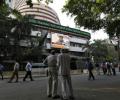
In the broader markets, BSE Midcap index slipped 0.3% whereas the BSE Smallcap index inched up by 0.2%
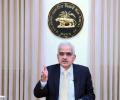
The challenge for the RBI in 2024 is likely to be less about containing elevated inflation and more about curbing excessive financial market exuberance and a 'problem of plenty', notes Sajjid Chinoy, Chief India Economist JP Morgan.
The 30-share Sensex closed 80 points lower at 21,753 levels while the 50-unit NSE Nifty index was down 38 points at 6486 levels. Benchmarks plunged to their lowest levels since March 06, 2014.
US Federal Reserve Chairper Janet Yellen hinted at raising interest rates sooner than expected, in her first press conference after assuming the top job at US central bank.
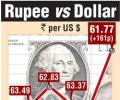
The partially convertible rupee closed at 61.77/78 per dollar compared to its close of 63.38/39 on Wednesday.

The rupee plunged 90 paise to close at an all-time low of 80.86 (provisional) against the US dollar on Thursday after the US Federal Reserve's interest rate hike and its hawkish stance weighed on investor sentiments. Forex traders said the US Fed's rate hike and escalation of geopolitical risk in Ukraine sapped risk appetite. Moreover, the strength of the American currency in the overseas market, a muted trend in domestic equities, risk-off mood and firm crude oil prices weighed on the rupee.

Unlike any other business, banking is a turf where the captain's role is the most critical. Often a bank is defined by the personality of the CEO who runs it. Both HDFC Bank and Kotak Mahindra Bank are the creation of their CEOs, notes Tamal Bandyopadhyay.

The reason for the stickiness in bond yields can be many, but the most responsible is the liquidity deficit stance taken by RBI, says Anup Roy.

The rupee had revisited the near 2-month low of 60.55 per dollar earlier in the session.

A day after BRICS (Brazil, Russia, India, China and South Africa) nations agreed on a $100-billion foreign currency reserve pool to tackle the volatile foreign exchange markets, India on Friday said the pool would act as a buffer arrangement, adding it might not withdraw anything from this reserve.

A total of 161.30 acres of land, plant, machinery and building of the Kannad Sahakari Sakhar Karkhana Limited (Kannad SSK) located in Kannad village of Aurangabad district has been provisionally attached under the Prevention of Money Laundering Act (PMLA), the ED said in a statement.

Investors have scaled back their allocation to equities as pessimism has reached "dire" levels due to cloudy economic outlook, according to the latest Bank of America (BofA) monthly global fund manager survey that covered nearly 300 money managers with combined assets of $800 billion. The survey showed that the expectations for global growth and profits are at all-time lows and cash levels are at highest since the 9/11 attacks. Interest rate hikes by central banks, the unwinding of an easy monetary regime, disruptions in global supply chains, and fears of recession have heightened market volatility since the beginning of the year.
.jpg)
The Indian rupee touched record low of 65.52/dollar on Thursday and is down 16 per cent so far this year despite efforts by policymakers to prop it up.

Bankers say loan demand was more muted this festival season than last year.

IPO market hopes to come out of slump in festive season, reports Sundar Sethuraman.

Consumer goods firms and auto companies are witnessing an upturn in rural demand, which had been lagging for most of FY24. Expectations of a bumper rabi crop harvest have helped turn the tide. The Reserve Bank of India's (RBI's) Monetary Policy Committee kept the repo rate unchanged last week, noting that as rural demand catches up, consumption is expected to support economic growth in 2024-25.

Banks such as IndusInd Bank, Federal Bank, DCB Bank and Axis Bank which have renewed their focus on secured loans may be, hence, walking on a tightrope.

The rising dependence on discounted crude oil has resulted in India's trade deficit with Russia hitting the second-highest place last year, after China, reveals Department of Commerce data. From April through January 2022-23 (FY23), India's maximum trade deficit was with China, at $71.58 billion. This was followed by Russia, where the deficit expanded sevenfold - from $4.86 billion in April-January of 2021-22 (FY22) to $34.79 billion during the same period in FY23.

The central bank had revised its inflation forecast significantly downward in the last policy

Education finance is a complex and dynamic sector. There are too many variables -- the course, the calibre of students, the universities, and the job prospects once the course is over, notes Tamal Bandyopadhyay.

'Rate cut should reiterate RBI's commitment in providing confidence to consumers and small business.'

Goldman Sachs downgraded its rating on Indian stocks to 'underweight'.

Unlike in the past, when old private banks compromised upon underwriting standards to take on the bulk, they've now realised that scaling up at the cost of quality isn't worth the while. These banks have also readjusted growth targets when required, and rebalanced books to preserve capital and asset quality.
The central bank also left the benchmark rates unchanged in the range of 0 to 0.25 per cent. The Federal Open Market Committee which decides on the key rates has retained the same near zero and said economic conditions warrant 'exceptionally low levels' of federal fundsfor a longer period.

India was less directly affected by the Chinese stock market rout and yuan devaluation that battered currencies and markets in the region.
